

Blog
Fix a Sore Throat After Vaping in 2–4 Days with Device and E Liquid Changes


Most sore throats after vaping come from airway dryness or chemical irritation, not infection, and they usually settle within a couple of days once you stop or cut back. Try hydration, salt gargles or a lozenge first. If you have breathing difficulty, can’t swallow, are drooling, or have a high fever, that’s not a vaping throat anymore. That needs urgent medical care.
TL;DR:
- Throat irritation from vaping is mostly caused by airway dryness from PG, high heat, or irritating flavouring chemicals, and typically resolves in a few days.
- Reducing nicotine strength, switching to higher VG e-liquids, lowering device temperature, and maintaining device hygiene can prevent recurring irritation.
- Severe symptoms such as difficulty swallowing, breathing, or high fever require urgent medical attention, as they indicate a serious condition.
- Most cases of vaping-related throat pain are mild and self-limiting, but persistent symptoms beyond a week should prompt a healthcare consultation.
- Vaping causes milder throat irritation than smoking but still involves risks like dehydration and chemical sensitivity, which can be mitigated by careful device and liquid choices.
Table of Contents
- Why does vaping hurt my throat? The real causes
- How common is throat irritation from vaping, and how long does it last?
- How to relieve vaping throat pain right now
- When throat pain from vaping needs a doctor
- Adjusting your device and e‑liquid to stop the irritation returning
- Could vaping cause lasting throat damage?
- Vaping vs smoking vs other throat irritants: what’s actually worse?
- Do flavoured e‑liquids irritate the throat more than unflavoured ones?
- Our perspective on vaping throat irritation
- If you want gentler options on your throat
- Sources
- FAQ
Why does vaping hurt my throat? The real causes
Throat irritation from vaping usually comes down to what’s in the vapour and how hot it gets before it hits your throat. Propylene glycol (PG) is hygroscopic, meaning it pulls moisture out of whatever it touches, including your mucous membranes. That’s the dry, slightly scratchy feeling a lot of vapers describe after a session on a high‑PG e‑liquid. Vegetable glycerin (VG) is thicker and less drying, which is why switching the ratio changes how a throat feels almost immediately.
Nicotine adds its own layer to this. Higher nicotine strengths produce a stronger “throat hit”, the sharp, tightening sensation smokers associate with a real cigarette. That sensation is partly the point for some vapers, but pushed too far it tips into genuine irritation.
Heat matters just as much as ingredients. A “dry hit”, where you inhale after the wick has run out of liquid, sends scorched vapour straight into your throat and can cause an acute burning sensation that lingers for hours.
Other contributors worth ruling out:
- Flavouring chemicals — some flavour compounds, particularly cinnamon and certain buttery or creamy notes, are more irritating to the airway than others.
- Contaminants or metal particles — poorly made coils or counterfeit e‑liquids can shed particles that inflame throat tissue.
- Reflux — acid reflux can mimic vaping-related throat pain, especially if symptoms are worse in the morning.
- Concurrent smoking or allergies — many vapers still smoke occasionally or have seasonal allergies that compound the irritation.
Health authorities note that vaping is an inhalational exposure that can irritate the airways and contribute to cough or throat inflammation, so ruling out other causes matters before you settle on “it’s just the vape.”
How common is throat irritation from vaping, and how long does it last?
Throat irritation is the single most reported side effect among vapers, but it’s not universal, and for most people it resolves quickly. In the 2020 ITC Four Country Smoking and Vaping Survey, 5.8% of vapers reported throat irritation, out of the 12.9% who reported any negative side effect at all.
By the numbers: Only a small fraction of people bothered seeking medical advice for it, which tells you most people treat it as a minor, self-limiting nuisance rather than a medical event.
Mild irritation from vaping typically clears within two to four days once you reduce exposure or adjust your setup. If it drags on past a week, something else is likely going on: reflux, a viral infection, or a device fault causing repeated dry hits. Newer vapers report symptoms more often than experienced users, which points to technique and adaptation playing a real role. People who’ve just switched from smoking, or who are still dual-using, also tend to report more throat symptoms, likely because their airways are already irritated from combustion.
How to relieve vaping throat pain right now
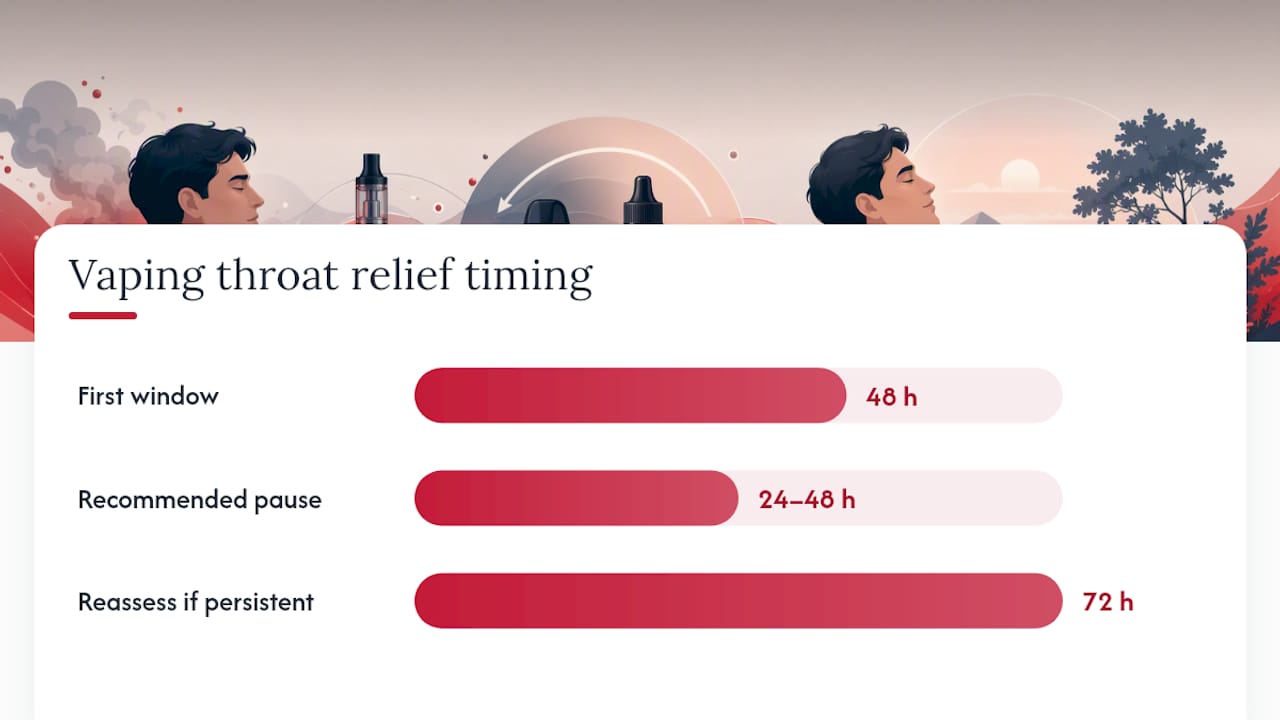
Getting through the first 48 hours is mostly about giving your throat a break from further irritation while you calm things down.
- Pause or reduce vaping for 24 to 48 hours. This is the single most effective step, since continued exposure keeps re-irritating already inflamed tissue.
- Hydrate consistently. Water, herbal tea, and warm (not scalding) drinks help counter the drying effect of PG and keep mucous membranes functional.
- Gargle with warm salt water. A teaspoon of salt in a warm glass of water, gargled a few times a day, is a standard recommendation for sore throat relief generally.
- Use throat lozenges or a cool-mist humidifier. Both add moisture back to irritated tissue, especially useful overnight.
- Take paracetamol or ibuprofen if pain is significant. Standard over-the-counter dosing is fine for short-term discomfort; check the packet for adult dosing limits.
- Rest your voice if you’re hoarse. Talking less gives inflamed vocal folds and throat tissue a chance to settle.
Avoid decongestants during this window. They dry out mucous membranes further, which works against everything you’re trying to do.
Pro Tip: If your throat still feels raw after 72 hours despite cutting back and following these steps, that’s your cue to look at your device or e‑liquid rather than just waiting it out. Persistent irritation past three days is a signal, not a coincidence.
When throat pain from vaping needs a doctor
Most vaping-related throat discomfort is uncomfortable, not dangerous. But a small set of symptoms cross the line from “manage it at home” to “get seen today.” Health authorities are specific about this threshold, and it’s worth knowing exactly where it sits.
Seek urgent medical attention if you notice:
- Severe throat pain combined with drooling or difficulty managing your own saliva.
- Inability to swallow food, liquid, or even saliva comfortably.
- Any breathing difficulty, wheezing, or a feeling that your throat is closing.
- A high fever alongside throat pain.
- Symptoms that are rapidly worsening rather than plateauing or improving.
Healthdirect’s guidance recommends clinical review if a sore throat hasn’t improved within a week, even without those red flags. Clinicians who see a patient with severe throat symptoms will usually ask about vaping and smoking history as part of routine assessment, because it changes what they’re looking for. A documented case report described a previously healthy daily e‑cigarette user who developed acute epiglottitis, a rare but serious swelling of the flap that protects the airway. It’s an uncommon outcome, but it’s exactly why red flags exist: a visual exam, and sometimes an ENT referral or imaging, can rule out something more serious than dryness.
Adjusting your device and e‑liquid to stop the irritation returning
If throat irritation keeps coming back, the fix is usually in your setup rather than your habits alone. A few targeted swaps make a genuine difference for most people.
- Move toward higher VG, lower PG e‑liquids. VG-dominant liquids produce thicker vapour and a gentler throat sensation, and it’s a common enough fix that it’s worth trying before anything else. Browsing options across e‑liquids with different VG/PG ratios is a reasonable starting point.
- Reduce nicotine strength gradually. A harsh throat hit is often a nicotine-strength problem, not a flavour problem. Stepping down slowly avoids cravings while easing irritation.
- Lower your wattage or temperature setting. Chasing bigger clouds usually means more heat, and more heat means more irritation.
- Replace coils on schedule and avoid chain-vaping. A worn coil is far more likely to produce a dry hit, and back-to-back puffs don’t give the wick time to re-saturate. Replacement coils are cheap insurance against this.
- Choose milder flavours and buy only authorised e‑liquids. Strong cinnamon or dessert flavours are more likely to irritate; counterfeit liquids carry a higher contamination risk.
- Clean your device regularly. Residue buildup on connections and tanks can introduce irritants you wouldn’t otherwise be exposed to.
If irritation persists despite all of this, it’s worth considering nicotine alternatives such as nicotine pouches or gum that don’t involve inhalation at all, or speaking to a health professional about quitting support.
Could vaping cause lasting throat damage?
A single irritated throat episode is not evidence of long-term harm, but repeated, chronic irritation is a different question, and one researchers are still working through. Persistent low-grade inflammation of the throat and upper airway, if it happens week after week for months or years, is the kind of exposure pattern that concerns respiratory specialists, even without a definitive long-term dataset yet.
What’s clearer is the acute-to-chronic pathway: repeated dry hits, heavy nicotine strengths, or daily heavy use create a cycle of inflammation, healing, and re-inflammation that never fully resolves. Vocal cord irritation from chronic vaping can also show up as ongoing hoarseness, a symptom some heavy vapers report as a baseline rather than an occasional flare.
The practical takeaway isn’t to panic over one bad night. It’s to treat recurring throat symptoms as a pattern worth interrupting rather than a cost of doing business. If your throat is sore most weeks rather than occasionally, that’s a different situation to a single rough day, and it justifies the device and liquid changes covered above, plus a conversation with a GP if it doesn’t resolve.
Vaping vs smoking vs other throat irritants: what’s actually worse?
Comparing vaping to smoking on throat irritation isn’t a like-for-like exercise, because the mechanisms differ even when the symptom looks the same. Cigarette smoke contains thousands of combustion byproducts, including tar and carbon monoxide, which chronically inflame the entire respiratory tract. Vaping avoids combustion, but PG’s drying effect and the heat from certain devices create a different, generally milder, irritation pathway.
Dry mouth or throat, along with cough, rank among the most commonly reported symptoms users attribute to e‑cigarettes, similar to what smokers report, though generally described as less severe. That doesn’t mean vaping is harmless for the throat. It means the injury pattern is different: less tar-driven chronic damage, more dehydration and chemical-flavour sensitivity.
Other everyday irritants worth ruling out before blaming your device: dry indoor heating or air conditioning, seasonal allergies, viral pharyngitis, and acid reflux, particularly if your throat feels worse first thing in the morning rather than after vaping sessions specifically. If you smoke and vape, teasing apart which one is responsible gets harder, and quitting one while continuing the other rarely gives you a clean answer.
Do flavoured e‑liquids irritate the throat more than unflavoured ones?
Flavour choice genuinely changes how your throat feels, and it’s one of the easier variables to control. Unflavoured or simple menthol/tobacco liquids tend to produce less throat irritation than heavily flavoured options, particularly cinnamon-based flavours (cinnamaldehyde is a known airway irritant in concentrated form) and rich dessert or bakery flavours that use higher concentrations of flavouring compounds to achieve their taste.
Fruit flavours sit somewhere in the middle, generally milder than dessert flavours but still more irritating than plain liquids for some vapers. This is highly individual: one person tolerates a strawberry-based liquid fine while another finds it scratchy after a single session.
If you’re troubleshooting recurring throat pain, doing a simple elimination test, switching to a plain or lightly flavoured liquid for a week, tells you more than guessing. Long-duration disposables and pod systems vary in flavour intensity by design, so if you’ve been using a heavily flavoured device daily, that’s a reasonable first variable to change before assuming it’s your PG/VG ratio or nicotine strength causing the problem.
Our perspective on vaping throat irritation
The gap between what people expect from a “throat hit” and what actually causes lasting irritation is bigger than most vapers realise. A sharp throat hit is often marketed and chosen as a feature, the thing that makes vaping feel satisfying after quitting cigarettes. But there’s a real difference between a brief, intentional throat hit and the chronic, low-grade irritation that comes from a poorly matched nicotine strength, an ageing coil, or a liquid with a PG ratio that’s wrong for your physiology.
What we hear most often from customers isn’t dramatic. It’s the slow realisation that a scratchy throat they’d accepted as normal actually resolved once they moved to a higher VG liquid or replaced a coil they’d been putting off changing. Sourcing matters here too: authorised, correctly labelled e‑liquids remove one whole category of risk, contamination and mislabelled nicotine strength, that counterfeit products introduce. Our guides exist because most throat irritation is genuinely fixable with the right adjustments, not because every case needs a medical workup. But we’d rather a customer see a GP unnecessarily than ignore a red flag because they assumed it was “just vaping.”
— Alison
If you want gentler options on your throat
Vaping doesn’t have to mean choosing between flavour and comfort. There are e‑liquids available across the full VG/PG spectrum and nicotine-free options, so if your throat’s been telling you something, you’ve got a real adjustment to make rather than just cutting back and hoping.

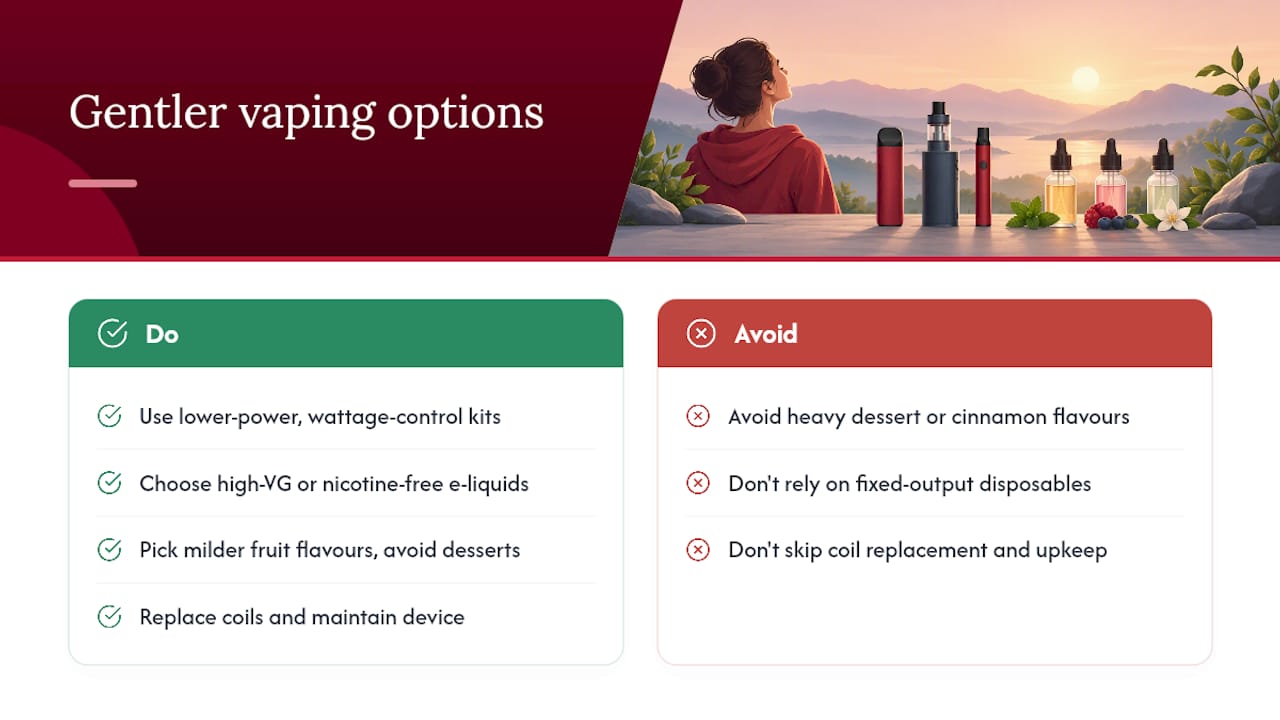
Start with the basics: if you’re chasing a lower throat hit, browse vape kits built for lower-power setups where you control wattage directly, rather than a fixed-output disposable. If you suspect your liquid’s PG content is the culprit, our e‑liquids range lets you filter by VG/PG ratio and nicotine strength, including nicotine-free formulations like the IGET Goat 5000 for anyone wanting to remove nicotine from the equation entirely. For flavour, milder fruit options such as the Strawberry Peach disposable or the Strawberry Lychee ALIBARBAR Ingot tend to sit easier than heavy dessert blends, while the ALIBARBAR Skittles 9000 Puffs is worth trying if you want something fruitier without the cinnamon or bakery notes that irritate more. Don’t neglect maintenance either: fresh replacement coils and general vape accessories keep your device from producing the scorched, dry-hit vapour that causes acute burning. All stock is sourced from authorised distributors, so what’s on the label is what’s in the bottle.
None of this replaces a doctor if your symptoms fit the red flags above. But if you’ve ruled those out and you’re just looking for a setup that’s kinder to your throat, our nicotine pouches and coil range is a good place to start browsing today.
This article is general information, not a substitute for advice from a qualified doctor. Consult a qualified healthcare professional about your own circumstances before acting on anything here.
Sources
- Prevalence and correlates of negative side effects from vaping nicotine: Findings from the 2020 ITC Four Country Smoking and Vaping Survey – PMC
- Vaping-induced acute epiglottitis: a case report
FAQ
How do I get rid of a sore throat from vaping?
Stop or reduce vaping for 24 to 48 hours, hydrate consistently, and gargle with warm salt water several times a day. Lozenges, a cool-mist humidifier, and standard paracetamol or ibuprofen dosing help with pain in the meantime, following Healthdirect’s sore throat guidance.
How long does a sore throat from vaping last?
Mild irritation typically improves within two to four days once you reduce exposure and follow basic self-care. If it’s still bothering you after a week, Healthdirect recommends getting it checked, since something other than vaping may be involved.
Can vaping damage your throat?
Vaping can cause acute irritation and dryness in most users, and dry mouth or throat ranks among the most commonly reported symptoms attributed to e-cigarettes. Serious throat conditions are rare, though a documented case report of acute epiglottitis shows severe outcomes, while uncommon, aren’t impossible.
What are the symptoms of vaping too much?
Common symptoms include throat irritation, dry mouth, cough, and headache, with throat irritation reported by 5.8% of vapers in a major international survey. Heavier use, higher nicotine strengths, and frequent dry hits tend to intensify these symptoms, and switching to a higher VG e‑liquid or lower nicotine strength often helps.
Is vaping bad for your throat compared to smoking?
Vaping generally causes milder throat irritation than smoking, since it avoids the combustion byproducts in cigarette smoke that drive chronic inflammation. It still isn’t risk-free: PG-based dryness, heat, and certain flavouring chemicals can irritate the throat, and choosing higher VG liquids or authorised products like those in our e‑liquids range can reduce that irritation.
Recommended
Created with BabyLoveGrowth to build domain authority

